Betting Exchange Trading Strategies
What Is Exchange Trading?
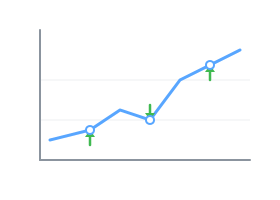
Betting exchange trading strategies turn you from a punter into a trader. You stop predicting winners and start profiting from price movement. Back at one price, lay at another, and pocket the difference — the match result becomes irrelevant.
Think of it like buying and selling stocks, except your market is a football match or a horse race. You take a position, wait for the price to shift in your favour, then close out. The exchange gives you both sides of every bet, which is what makes this work. Before you trade anything, though, get comfortable with how lay betting works — you will use it constantly.
Strategy 1: Back-to-Lay (Pre-Match)
This is where most traders start, and honestly, it is still one of the best strategies out there. You back a selection at a higher price and lay it off once the odds drop.
How it works:
- Back a team at higher odds (e.g., 3.00)
- Wait for the market to move — team news drops, money floods in, odds compress
- Lay the same team at shorter odds (e.g., 2.50)
- You now hold a guaranteed profit no matter who wins
When to use it: This shines in the hours before kick-off when line-ups get announced, late injury news breaks, or sharp money pushes a price down. You need to read the market and anticipate where the weight of money will land.
Example: You back Team A at 3.00 for 100 EUR. Two hours later, the star striker is confirmed fit, and the price drops to 2.50. You lay at 2.50 for 120 EUR. That locks in roughly 20 EUR profit before commission — win, lose, or draw.
Strategy 2: Lay-to-Back (Pre-Match)
The mirror image of back-to-lay. You lay first at a short price, then back at a longer one after the odds drift out.
How it works:
- Lay a selection at shorter odds (e.g., 2.00)
- Wait for odds to drift higher
- Back the same selection at longer odds (e.g., 2.30)
- Close the trade with profit locked in
When to use it: When you suspect bad news is coming — a key player is doubtful, the weather forecast just turned ugly, or the early market money looks like casual punters overhyping a favourite. Fair warning: this one carries more heat than back-to-lay because your lay liability sits open until you close. If the odds keep shortening instead of drifting, you eat the loss or hold your nerve.
Strategy 3: In-Play Trading
This is the strategy that separates hobbyists from serious traders. You trade live events as odds swing with every goal, red card, and momentum shift. The profits can be significant. So can the losses if you do not know what you are doing.
Key principles:
- A goal sends the scoring team's odds plummeting — sometimes two or three ticks in a single second
- A conceded goal or missed penalty pushes odds out just as aggressively
- In-play volatility creates more opportunities in 90 minutes than pre-match does in a week
- Execution speed is everything — a one-second delay can wipe out your entire margin
Common in-play approach: Back the underdog pre-match, then lay them off if the favourite goes behind early (the underdog's odds crater because the scoreline favours them). You can also trade momentum swings within a half. Getting familiar with exchange mechanics and order books gives you a real edge here — you will spot where the liquidity sits and avoid getting trapped in thin markets.
Strategy 4: Scalping
Scalping gets hyped a lot online, and I want to be straight with you: it works, but it is not the easy money some people claim. You grab tiny profits from the back-lay spread over and over, hundreds of times per session.
How it works:
- Place a back bet at the current back price
- Immediately queue a lay bet one tick lower
- When both sides match, you bank the spread
- Move to the next market and repeat
Requirements: You need deep liquidity, razor-sharp execution, and ironclad discipline. Stick to Premier League football and the bigger horse racing meetings where the books are thick and the spreads stay tight. Each trade might net you less than 1 EUR. That sounds pathetic until you do it 200 times on a Saturday afternoon. The problem? One sloppy trade where you fail to exit can eat 50 good ones. Scalping rewards consistency, not boldness.
Strategy 5: Swing Trading
Swing trading is the slow game. You hold positions for hours, sometimes days, targeting big price moves driven by news or market sentiment.
How it works:
- Spot a market where odds should move significantly — maybe a team is expected to confirm a transfer or a key player's fitness test is pending
- Take your position early, before the crowd catches on
- Close out once the price moves to your target
Of all the betting exchange trading strategies on this list, swing trading demands the least screen time. You do not need to babysit charts all day. But you do need sharp judgement about what moves markets and the patience to sit on a position that might go against you before it comes good. If you hate waiting, skip this one.
Risk Management for Traders
Here is what took me far too long to learn: your strategy matters less than your risk management. I have watched talented traders blow up their banks because they refused to take a loss.
- Always set a stop-loss — Pick your exit point before you enter the trade. When the price hits it, you get out. No renegotiating with yourself, no "it will come back." Cut it and move on
- Trade liquid markets only — If you cannot close your position instantly, you are gambling, not trading. Thin markets trap you with wide spreads and unmatched bets
- Start small — Trade with stakes so low that losing feels boring. Seriously. If your heart rate goes up, your stakes are too big for your experience level
- Track every trade — Log your entry price, exit price, profit or loss, and most importantly, why you took the trade
I will push this point harder because it matters. Keep a proper trading journal. Not just the numbers — write down what you saw in the market, what triggered your entry, and what you were feeling. After four or five weeks of honest logging, you will notice patterns you never saw in real time. Maybe you overtrade on weekday evenings when the liquidity is poor. Maybe you consistently misjudge early kick-off markets. That kind of self-awareness is not glamorous, but it is the thing that turns a break-even trader into a profitable one. The traders who plateau almost always skip this step.
Access Exchanges Through a Broker
Before you can trade any of these strategies, you need access to an exchange. For most people, the simplest path runs through a sports betting broker. A broker account opens up the major exchanges without geographic headaches, and you can fund your account and start placing trades the same day.
Broker platforms tend to offer features that matter for active traders — fast bet placement, live position tracking, and the ability to flip between exchanges without juggling logins. If you want to skip the hassle of direct registration and get straight into the markets, setting up an account through a reputable broker is the fastest route. Plenty of traders also prefer to access multiple exchanges from a single broker dashboard so they can compare liquidity across platforms before committing to a trade.
Access Betting Exchanges
Trade on Betfair, Orbit & more through a single broker account
Frequently Asked Questions
How much capital do I need to start exchange trading?
You can get started with 500 to 1,000 EUR, and that is a sensible range. Anything less and a short losing streak wipes you out before you have learned anything. The real point is not the exact number — it is having enough runway to survive the learning curve. You will make mistakes early on. Everyone does. Your bankroll needs to absorb those hits while you figure out which strategies suit your personality and schedule.
Is exchange trading guaranteed to be profitable?
Not even close. Anyone telling you otherwise is selling a course. Exchange trading is a skill, and like any skill, it takes months of deliberate practice to get good at. Most beginners lose money in the first few months. The ones who stick with it, track their results, and adjust their approach can absolutely turn a profit — but there are no guarantees and no shortcuts.
Which sports are best for exchange trading?
Football and horse racing dominate for good reason: deep liquidity, tight spreads, and predictable market rhythms. Most of my trading happens across the big European football leagues. Tennis is a strong third option, especially for in-play trading, because the constant back-and-forth of service games creates regular momentum swings that move the odds. Stay away from niche markets until you are consistently profitable in the main ones.
Related Guides
- Betting Exchanges — back to the betting exchanges overview
- Lay Betting Guide — master lay betting fundamentals
- How Betting Exchanges Work — understand exchange mechanics