Closing Line Value: The Ultimate Measure of Betting Skill
What Is Closing Line Value?
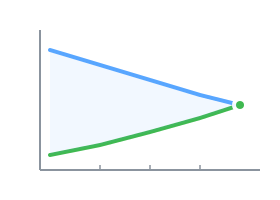
Closing line value (CLV) tells you one thing: did you grab better odds than the market's final price? The closing line — those last odds posted at kick-off — represents the sharpest probability estimate the market produces. Every sharp dollar, every model output, every piece of information gets baked into that final number.
Say you back a team at 2.20. By kick-off, the line sits at 2.00. You beat the close by 10%. That is positive CLV — you spotted value before the market caught up. Do that consistently across thousands of bets, and you hold the single most reliable signal of long-term profitability.
Why CLV Matters More Than Results
Your win-loss record over 50, 100, even 200 bets tells you almost nothing. Variance dominates short-term results so completely that a losing month says zero about your skill. Neither does a winning one.
CLV strips away the noise. It measures your odds quality at the moment you place the bet — not whether some goalkeeper slipped on wet grass in the 89th minute. Think about it this way:
- Positive CLV, negative results — Your reads are sharp. Variance is working against you temporarily. Stay the course
- Negative CLV, positive results — You are running hot on bad bets. This always corrects
- Positive CLV, positive results — Skill plus good variance. Trust the CLV number, not the bankroll graph
Every serious bettor tracks closing line value betting performance as their north star. Not win rate. Not short-term ROI. CLV.
How to Calculate CLV
You divide your odds by the closing odds, then subtract 1. That is it.
CLV = (Your Odds / Closing Odds) - 1
| Your Odds | Closing Odds | CLV | Interpretation |
|---|---|---|---|
| 2.20 | 2.00 | +10% | Strong positive CLV |
| 1.95 | 2.00 | -2.5% | Slightly negative CLV |
| 3.50 | 3.00 | +16.7% | Very strong positive CLV |
| 1.80 | 1.85 | -2.7% | Negative CLV |
Say you took 3.50 on an underdog and the market closed at 3.00. Divide 3.50 by 3.00, get 1.167, subtract 1, and you land at +16.7%. You do not need that one to win. You need to keep finding edges like that, and the math handles the rest. Average +2% to +5% CLV across a large sample and profit follows.
Where to Find Closing Lines
Use Pinnacle's closing odds as your benchmark. No debate here. Pinnacle runs the sharpest book on the planet, and their closing line is the closest thing to "true odds" that exists. Why?
- They take massive sharp action without gutting your account limits
- Their margins sit lower than any other bookmaker
- Their lines absorb intelligence from the widest pool of winning bettors worldwide
Access Pinnacle odds — directly or through a broker — if you want to track CLV with any credibility. Learning what makes a bettor sharp explains why Pinnacle's close serves as the gold standard.
CLV and Betting Brokers
Broker access gives you two concrete advantages when chasing positive CLV:
You hit sharp lines earlier — Brokers connect you to Pinnacle and other sharp books where early-posted lines still carry inefficiencies. That pre-correction window is where your edge lives.
You exploit soft book mispricing — When a soft book posts odds above Pinnacle's current number, you are almost certainly sitting on positive CLV. Finding value through broker access becomes repeatable once you anchor everything to CLV.
Pros consistently report 3-5% average CLV when hitting early lines through broker-connected sharp books. The sweet spot? Lines posted 12-24 hours before kick-off, before bookmakers absorb the full weight of sharp money. Bet in that window, then watch the line move. If it keeps drifting your way, you have your answer.
Tracking CLV Over Time
You cannot manage what you do not measure. For meaningful CLV tracking, get these in place:
- A record of every bet — odds taken, stake, and timestamp
- Closing odds data from Pinnacle or another sharp source
- At least 500-1,000 bets before drawing real conclusions
- A spreadsheet or tracking tool that handles the CLV math automatically
Dedicated tracking software that pulls closing lines automatically saves you hours. Manual tracking works, but be honest about whether you will stick with it at scale.
Common CLV Misconceptions
- "I do not need CLV if I am profitable" — Profitable over how many bets? You could be one cold streak away from realizing you never had an edge
- "CLV only works for pre-match bets" — Trickier to measure live, but any bet with a closing line can be evaluated this way
- "Positive CLV guarantees profit" — Not over 50 bets. Over 5,000? Positive CLV and profitability walk hand in hand
Put Your Strategy Into Practice
Closing line value betting knowledge means nothing if you cannot access sharp odds before the market corrects. That requires accounts that do not slash your limits the moment you win — exactly what betting brokers solve. Without broker access, most bettors watch their early-line edge vanish within weeks.
Turn CLV tracking from theory into habit. Access sharp odds through a broker and start measuring whether your process actually beats the close. That data speaks louder than any hot streak.
Access Sharp Bookmakers
Pinnacle, ISN & Asian sharps — no restrictions, no limits
Frequently Asked Questions
What CLV percentage should I aim for?
Aim for +2% to +5% average CLV across all your bets. That range puts you firmly in profitable territory over a large sample. Even +1% matters at high volume — small edges compound fast across thousands of bets.
Can I have positive CLV and still lose money?
Yes, and it will happen. You can run a +3% CLV average and still hit a brutal losing stretch. But over thousands of bets, positive CLV converges toward profit. Trust the process, not the current balance.
Is CLV relevant for exchange bettors?
Not as directly. Exchange odds shift constantly with live market activity, making a true "closing line" hard to pin down. CLV works best measured against a sharp bookmaker's final price — that gives you a stable benchmark.
Related Guides
- Professional Sports Betting — back to the professional betting overview
- Sharp Bettor Guide — the mindset behind CLV tracking
- Value Betting With Brokers — systematic value identification